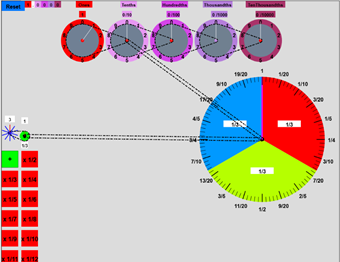
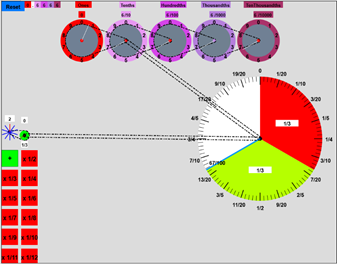
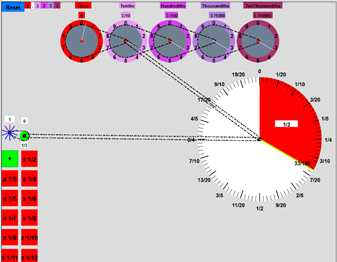
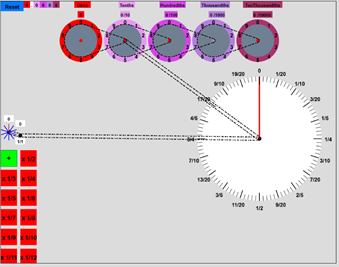
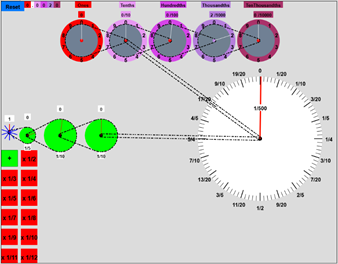
The purpose of this model is to illustrate
that fractions can be represented, or at least approximated to any degree of
accuracy, by “decimal expansions”, i.e., sums of inverse powers of 10. As shown in the sequence of screen shots
above, the initial configuration consists of a fraction wheel marked off into
decimal units of 100ths and 10ths, a set of fraction buttons indicating that
the indicated fraction will be multiplied, and an assembly of decimal “clocks”
labeled from left to right as “ones”, “tenths”, “hundredths”, etc. with the fraction
wheel connected to the “tenths” clock in a 1 to 1 input to output ratio so that
one full turn of the fraction wheel results in one full turn of the “tenths”
clock thus representing 10 tenths = 1. The “tenths” clock is connected to “ones” clock in a 10 to one ratio of input to output so that
one full turn of the tenths clock advances the “ones” clock by one unit. The “tenths” clock is connected to the
“hundredths” clock in a 1 to 10 ratio, the “hundredths” to the “thousandths” in
a 1 to 10 ratio, and the same for the “thousandths” to the “ten
thousandths”. Thus, each clock in the
assembly is 10 times more sensitive than the clock immediately to its
left. While the model stops at “ten
thousandths” we can easily imagine extending the decimal clocks to the right
arbitrarily to achieve any degree of sensitivity. As the fraction wheel turns, the current
digit for each clock is displayed above the clock and in the corresponding
place in a decimal expansion at the top left.
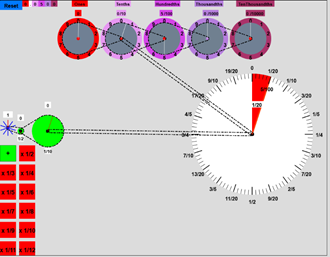
The images above show the initial display and the display after each of
3 turns for the fraction 1/3. The
decimal expansions for these are “0.0000”,”0.3333”, “0.6666”, and
“1.0000”. The next two images show the
display after one turn for 1/5 x 1/10 and 1/5 x 1/10 x 1/10 where the
respective decimal expansions are “0.0200” representing 2/100 and “0.0020”
representing 2/1000. The fact that the
hands of the last clocks in these two cases point directly to a digit rather
than between two digits as is the case for the expansion for one third is an
indication that the decimal expansion is “exhausted” and so all the remaining
digits are 0. (If we still used analog
clocks we could relate this to the hour or minute hand pointing directly to a
numeral.)