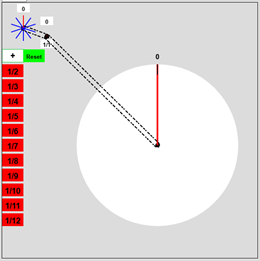
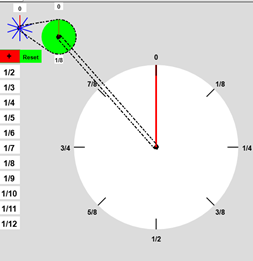
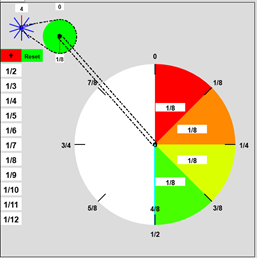
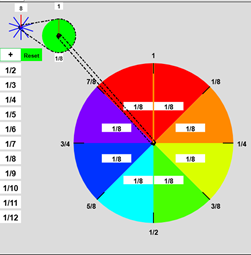
The purpose of this application is to give students models of fractions. When started, the student is presented with two “wheels”: a paddle wheel pulley and a blank disk (the fraction “wheel”) with a radial arm, connected by a compound pulley so that when the paddle wheel is turned, the radial arm is turned coloring the sectors of the disc it sweeps out. In addition, there are buttons labeled “1/n”, n = 2, ..., 12. When the button “1/n” is clicked, the output pulley from the paddle wheel pulley is replaced by one n-times the radius of the paddle wheel pulley so that n turns of the paddle wheel are required to turn the radial arm one full turn and thus one turn of the paddle wheel colors (1/n)th of the fraction wheel as seen in the images above for the example of “1/8”. The endpoints of the arm for multiple turns are labeled with the corresponding fractions, 1/n, 2/n etc. in reduced form, e.g. 0, 1/8, 1/4, 3/8, 1/2, 5/8, 3/4, 7/8. As the arm is turned, the unreduced form of the fraction, e.g., “4/8”, is displayed on the radius to the current fraction. The sectors are labeled with the fractional area of the whole disk of the sector. The visual models that can be observed are the area of the sectors (1/n) relative to the whole disk, the fractional length of the external circle swept out (0, 1/n, 2/n,...) and finally the compound pulley itself that drives the behavior by the 1:n ratio of output turns to input turns. The use of the pulley in this way makes a connection between fractions and “simple machines” which could be illustrated by the gears and chain on a bicycle. Another point of interest is why for certain fractions (1/2, 1/3, 1/5,1/7,1/11) there are no changes in the reduced forms.