Train
Track Addition
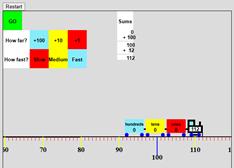
This model consists of a “railroad track” represented as a line marked off with unit tick marks having multiples of 10 and 100 distinguished by length and color, a train with cars labeled “hundreds”, “tens”, and “ones” which will specify how far the train is to travel on its next trip, buttons for setting the distance, a “GO” button for starting the train, buttons for setting the speed, and a column labeled “Sums” expressing the total distance traveled over multiple trips as a sequence of sums. The goal of the model is to illustrate several concepts including the use of position on a “number line” to represent numbers, the use of an intruction to change the location as an alternative model, and the sequencing of instructions as a model of addition. The duality of representations of number is common to models of number based on the state of a dynamic system, i.e., systems subject to change. In the first level a number is represented as a state of the system. At the next level number is represented as an instruction which causes the system state to change from the 0 state to the given state. The Addition “m+n” is thus represented as “execute m and then execute n”. For the model of number as a collection of objects “m+n” would be represented as “add m objects” and then “add n objects.” For the train system, m+n would be represented as “go a distance m” and then “go a distance n.” For the counting system “m+n” would be represented as “count the next m numbers” and then “count the next n numbers.” When we discuss multiplication, we will introduce a third level of interpretation of number: numbers as repeat operators.